If you look only at Niche or U.S. News, Aragon comes across as a powerhouse—A+ overall, #87 in California, #1 in the San Mateo Union High School District.
But when an admissions officer sits down with your transcript and school profile, the story they see is far more specific: a school with rigor bottlenecks, strict limits in STEM sequencing, and a compressed range of high-achieving students. At a place like Aragon, how you’ve taken advantage of what’s available to you is what helps you stand out. Strong numbers here blend together quickly. Distinctive narrative and high performance within the Aragon context are what matter.
This post walks through how AOs read Aragon applications, what the rankings do not capture, and how families can think strategically about standing out in an environment where many students look similarly strong on paper.
Aragon High School Ranking
According to Niche, Aragon earns:
- A+ Overall Grade
- #47 Best Public High Schools in California
- #95 Best College Prep Public High Schools in California
- A-grade academics and college prep
U.S. News ranks Aragon:
- #667 nationally
- #87 in California
- #18 in the SF Metro Area
- #1 in San Mateo Union High School District
These are excellent public-school rankings and accurately reflect the school’s solid academics and performance metrics.
But these rankings are not what admissions officers look at.
Admissions officers evaluate students in the context of their school using the school profile, year-over-year data, and the applicant pool from Aragon itself. Their question is always, “Did this student make the most of what Aragon offers?”
Aragon High School Profile
The Aragon 2025–2026 School Profile tells us a lot about how AOs interpret academic performance from this school.
Some important highlights include:
School Environment
- 1656 students; 434 2025 graduates
- Average class size: 33:1
- 331:1 counselor caseload
- Highest transfer request rate in SMUHSD (signals demand and competitiveness)
Academic Structure
- 7-period day block schedule
- 9th graders are recommended to take six classes
- Sophomores & juniors take 6 - 7 classes and seniors must take 4 but are encouraged to take 5 or more
Rigor (AOs pay close attention here)
- Students may take only one math and one science course per year. This is a major structural constraint compared to neighboring high schools. AOs evaluate STEM rigor within this limit; they do not penalize students for something the school does not allow.
- Advanced Standing (AS) classes in 9th & 10th grade provide rigor but are not weighted
- Oversubscribed AP STEM courses (Biology, Chemistry, Physics, CS, etc.) give priority to juniors and seniors
GPA + Academic Context
- No class rank reported
- Weighted GPA is provided and follows UC/CSU policy
- The profile does give an unweighted GPA distribution. We see that ~55% of students have a 3.5 - 4.0 unweighted GPA, which is a compressed range at the top of the GPA spectrum.
Why all this matters for admissions
Aragon’s profile tells AOs that a high percentage of students earn strong GPAs. The math and science course limit means the “most demanding” curriculum may look different here than at other Bay Area schools. Because of factors like this, AOs compare you primarily to other Aragon students, not students from Gunn, Lynbrook, Harker, etc.
When many students appear similarly strong academically, differentiation comes from how you used electives and DE courses, whether you maximized AP availability in 11th/12th grade, your sustained involvement and impact outside the classroom, the clarity and cohesion of your application narrative.
How Admissions Officers Read Students from Aragon
Admissions officers evaluate Aragon students within a “school group,” or the other students from your class who have also applied. So when your AO opens your application, they aren’t doing so randomly within a pile of other Bay Area applicants; they’re doing it systematically as they go through each application from your school.
How the school group system works
To assess your application, admissions officers generally go through a few steps.
- Sort by GPA and rigor within Aragon
First, they sort by GPA, usually weighted, to get a sense of the relative standing of each applicant since the school does not rank. - Compare rigor within Aragon’s constraints
A student who took all available advanced courses is generally seen as more competitive than one who opted for less challenging course pathways.They’ll evaluate your courses in relation to the school profile. - Compare year-over-year competitiveness
After looking at your application in relation to your classmates who have also applied, admissions officers may then turn to their own application history from Aragon. They’ll ask how your class compares to past years.
What this means for you
Being at a competitive school like Aragon does not give an automatic advantage. A strong GPA at a place like Aragon isn’t rare, so differentiation comes from your course rigor, extracurricular impact and initiative, and a cohesive narrative, not from your GPA alone.
UC Admissions Data for Aragon
The UC system releases admissions data for all California high schools. You can use this data to get a sense of how Aragon applicants tend to fare at different UC campuses.
UC Berkeley Admit Data (2024)
Start by taking a look at Aragon’s 2024 admissions data for UC Berkeley.
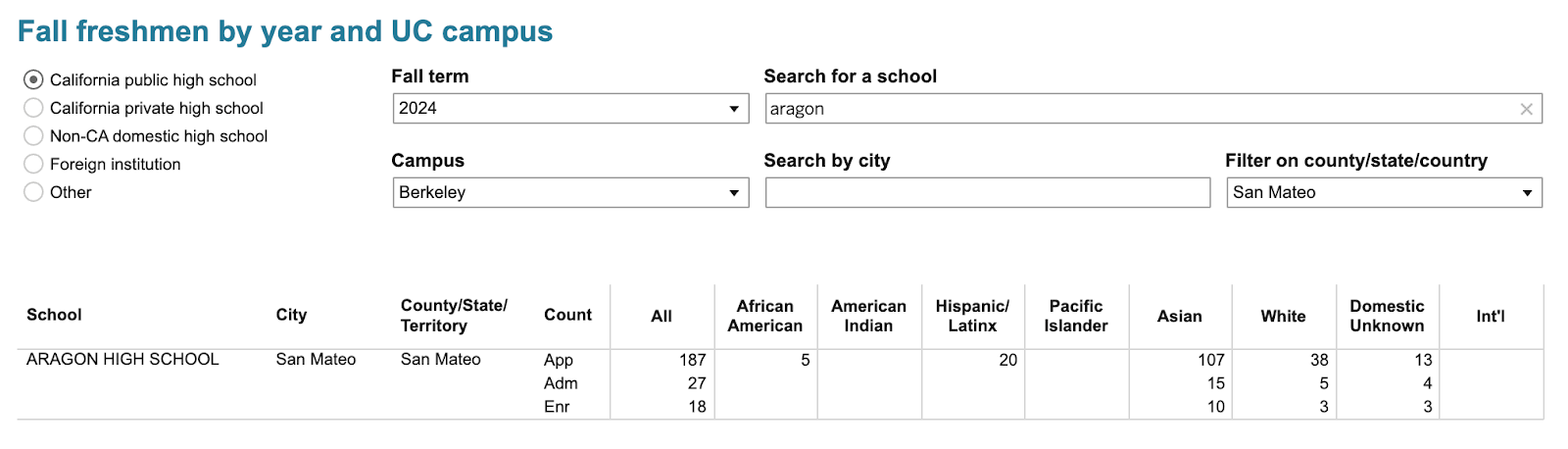
Of the 187 Aragon students who applied to Berkeley, 27 of them were admitted and 18 enrolled. That equals about a 14% admit rate from Aragon to UC Berkeley, which is about 2% higher than Berkeley’s overall admissions rate of about 12%. So on average, Aragon’s 2024 cohort did a little bit better than the whole Cal applicant pool, which may indicate that Berkeley admissions officers are willing to go slightly deeper into the class at Aragon than they are at other schools. Still, as you’ll see in the next section, Berkeley admits from AHS still have weighted GPAs about 4.2 and are still at the top of their class.
UC GPA Data for Aragon (2024)
This dataset also shows weighted UC GPA data for each UC campus:
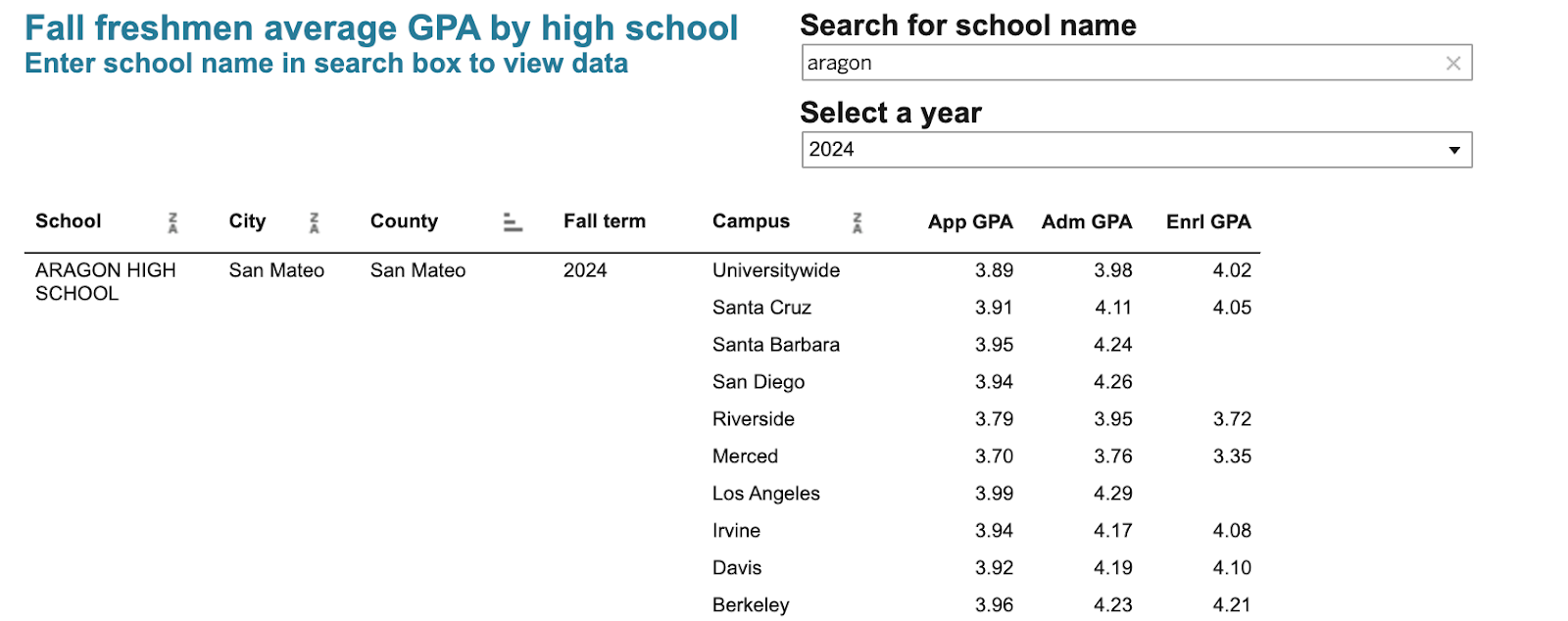
Big Takeaways
- The GPA thresholds for Aragon students are high across all campuses.
Even “mid-tier” UCs admit Aragon students with 3.9+ GPAs. - A weighted 4.0 at Aragon is not a guarantee of admission, especially to Berkeley/UCLA.
As you can see, Berkeley and UCLA admitted GPAs are well over 4.0. - Impact and PIQ storytelling now matter more than ever.
Strong stats at competitive Bay Area schools don’t differentiate by themselves. Your extracurriculars and application also have to work in your favor. - STEM caps at Aragon are understood by evaluators.
Admissions readers read within your school context, so they will not penalize you for not doubling in math/science. But they will also appreciate it if you figure out a way to pursue your STEM interests outside the classroom instead. - Berkeley’s ~14% admit rate from Aragon shows that even at a high-performing school, admission is selective and unpredictable.
Preparing a balanced school list is a must, even if you have strong academics and extracurriculars.
Strategic Takeaways for Aragon Families
For prospective families: Who thrives here?
Aragon is a strong environment for:
- Students who want breadth and depth across arts, biotech, languages, engineering pathways
- Students who appreciate structure and can handle a rigorous schedule
For current students: How to stand out in Aragon’s context
- Maximize rigor as much as is reasonable for you
AOs evaluate your choices relative to what Aragon allows. If you took the strongest schedule available to you, that is what matters. Decide what kind of course load you can reasonably manage. - Use electives and DE courses strategically
Biotech, business, digital media, and Kinesiology DE courses are meaningful ways to show depth and direction. However, be aware of these kinds of courses getting in the way of taking rigorous academic solids like English, math, social studies, and science. - Build a cohesive narrative
Your entire application and essays must connect your activities, values, and goals into one clear throughline. A cohesive narrative is necessary in addition to strong academics and extracurriculars for admission to selective schools.
For seniors and families: What really moves the needle
If you want help understanding how your student might be read within Aragon’s school group—or how to craft an application narrative that stands out—you can book a free intro call with our team.