Every fall, families in Belmont look at Carlmont’s strong Niche and U.S. News rankings and assume their student’s admissions odds should rise with the school’s reputation.
But selective colleges don’t admit high schools. They admit students within the context of what their school makes possible. And when admissions officers open a Carlmont file, they read it against a school profile packed with AP access, specialized academies like BTI, strong test scores, and a high-achieving peer group. That’s the real ranking that matters.
The takeaway: in selective admissions, your admissions strategy should work to help you stand out relative to Carlmont itself.
Carlmont High School Ranking
Carlmont boasts impressive public rankings:
- Niche ranks Carlmont:
- #60 Best Public High Schools in California
- #61 Best College Prep Public High Schools in California
- #91 Best STEM High Schools in California
- A+ overall
- And U.S. News says Carlmont is:
- #44 in California
- #349 nationally
- #193 in STEM
- Overall Score 98.05/100
These are strong rankings, especially in STEM and college prep.
But when an admissions officer reads your application, they aren’t looking at Niche or US News rankings.
Instead, they pull up your school profile, compare you to past Carlmont applicants, and assess your transcript within the specific academic ecosystem you come from.
Carlmont High School Profile
Carlmont’s school profile tells admissions officers exactly what students have access to, which helps them sort through all the Carlmont applicants to see who stands out.
Some highlights from the school profile include:
School Context
- 2,396 students across grades 9–12
- Draws from Belmont, San Carlos, Redwood Shores, Redwood City, East Palo Alto
Rigor Indicators
- 22 AP courses offered, including AP Physics C (Mech & E&M), AP Research, AP Seminar, AP CS A, AP Calc BC
- 7 Honors courses, plus accelerated AS tracks
- Dual Enrollment Biotech I–IV + Biomanufacturing fieldwork
- Students begin APs as early as 10th grade
- 1081 AP students and 2706 AP exams in 2025, with 95.6% scoring 3+ — a massive signal of academic competitiveness
Specialty Programs
- BTI (Biotechnology Institute): cross-curricular, science-intensive, but limits AP English & AP Social Studies access
- Media Arts Study pathway, AVID, Computer Science Pathway (3-course sequence)
- CTE pathways across business, marketing, digital media, robotics, and more
Course-Load Norms
- Most students take 6 courses, which AOs note when assessing rigor
- District does not rank, making GPA distribution and course load essential for comparison
What This Means for Admissions
Reading Carlmont apps, AOs ask:
- Did you pursue the most rigorous courses available within your pathway?
- Did you take advantage of the STEM depth here? Supplementary CTE programs?
- Are your AP counts and subject choices competitive compared to other Carlmont students?
Carlmont’s profile signals to AOs that Carlmont is a high-opportunity school. That’s the context in which they’ll evaluate your transcript.
How Admissions Officers Read Students from Carlmont
AOs begin by pulling up the “school group,” meaning all Carlmont applicants from that cycle.
They sort by:
- GPA
- Rigor by available opportunity
- Year-over-year comparisons with past applicants from Carlmont.
This school group evaluation means that Carlmont’s “ranking” doesn’t matter as much as your standing within your crop of Carlmont students. Admissions officers aren’t reading your application next to students from other schools in the Bay Area; they’re reading it alongside your Carlmont peers, past and present.
That’s why strategy matters so much here.
UC Admissions Data for Carlmont
The UC system releases admissions data for every high school in California. This data can be super helpful when thinking about your admissions strategy, especially at the UCs.
First, take a look at Carlmont’s admissions data to Berkeley, one of the most competitive UCs:
UC Berkeley Admit Counts (2024)
From Carlmont, Berkeley received 283 applicants and admitted 50 of them.
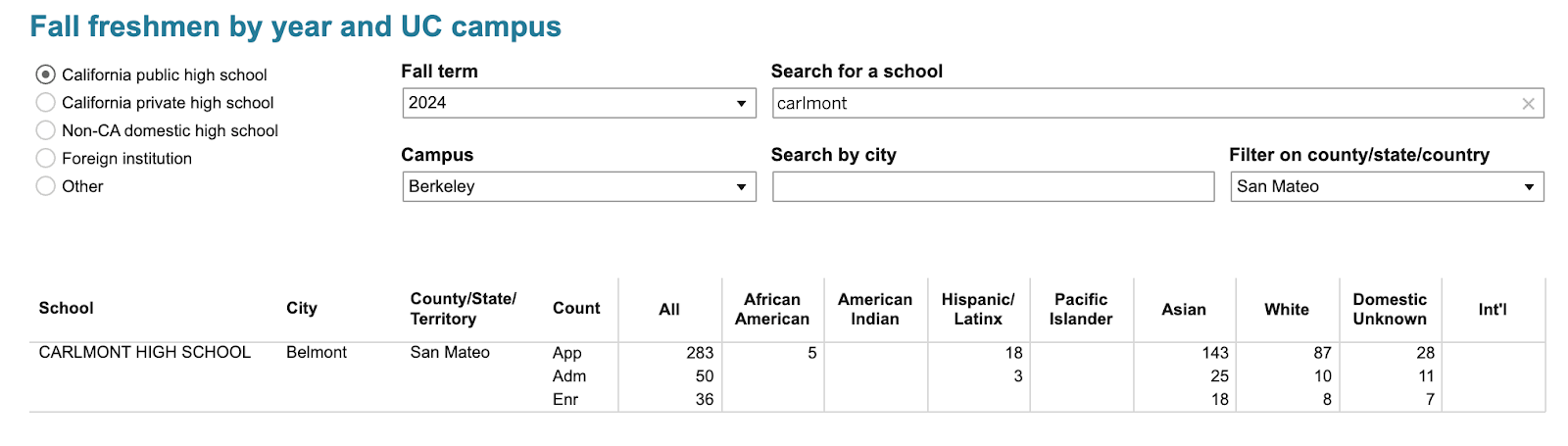
That’s over a 17% admit rate, which is a pretty big jump compared to Berkeley’s overall rate of about 12%. The higher Carlmont admit rate may indicate that Cal admissions officers are willing to go “deeper” into the class at Carlmont than they are at other schools, which means they might take a more serious look at your application even if you aren’t in the top 5-10% of your class.
But at UCLA, the Carlmont numbers are lower: 294 applied, and 22 were admitted (about a 7.5% admit rate), which is slightly lower than UCLA’s overall admit rate of about 9%.
A Carlmont applicant might, then, expect to have better odds at Cal than UCLA. Either way, nothing about UC admissions is a guarantee, and Berkeley and Cal are still reaches for everyone because of their low acceptance rates.
UC GPA Data
The UCs also give us a GPA breakdown for applicants, admits, and students who enrolled to each campus:
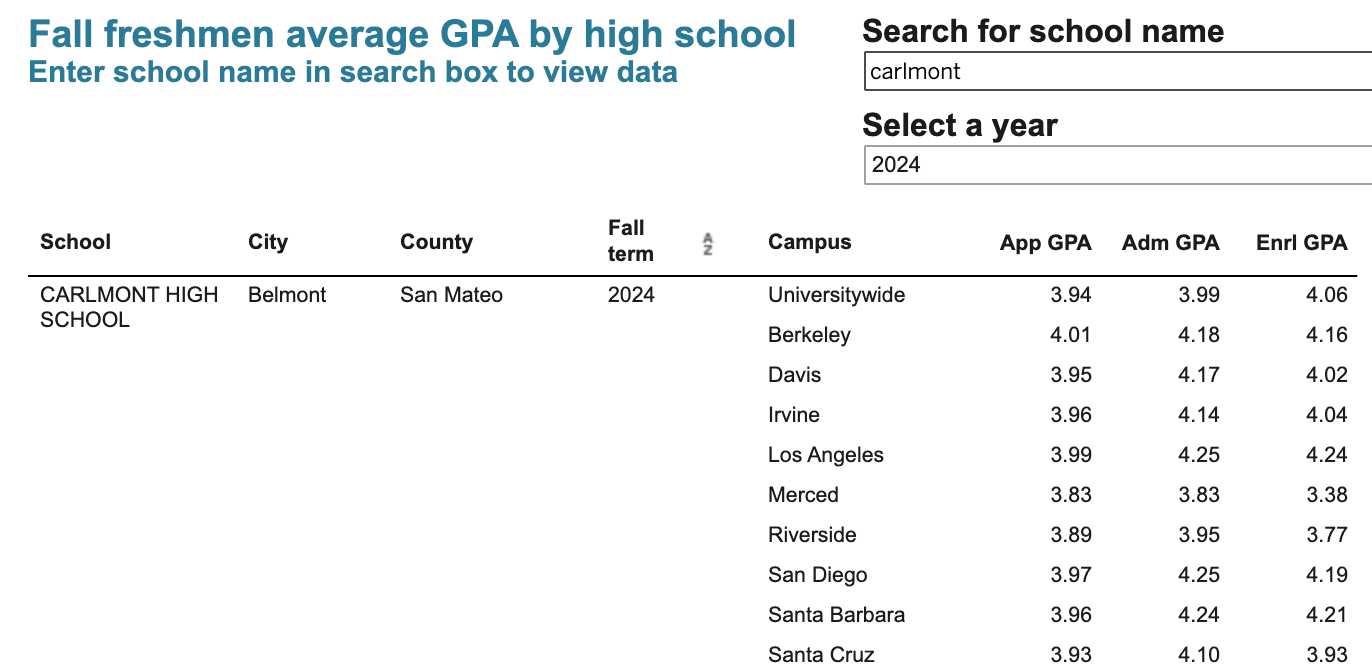
Some highlights:
- Berkeley:
- Applicant GPA: 4.01
- Admit GPA: 4.18
- Enroll GPA: 4.16
- UCLA:
- Applicant GPA: 3.99
- Admit GPA: 4.25
- Enroll GPA: 4.24
- UCSD / UCSB / Davis: All admit GPAs cluster in the 4.17 - 4.25 range.
The weighted GPAs of admits for all but Merced and Riverside were above the 4.0 mark. UCs reward extreme academic performance, and perfect or near-perfect transcripts from competitive schools are now common, not exceptional. To be competitive at most UC campuses, you’ll want to aim for a UC weighted GPA above 4.0.
What This Means for Carlmont Students
- A 4.0 GPA is not a guaranteed admit.
- Berkeley and UCLA admit GPAs for Carlmont students are above 4.1+ weighted.
- Other UC campuses like Merced and Riverside are more likely to admit lower GPAs.
The most selective UCs are now reach schools for most applicants—even very strong ones—because the admit rates are so low.
Strategic Takeaways for Carlmont Families
For Prospective Families
Carlmont is a great fit for students who:
- Thrive in rigorous STEM environments
- Want strong AP science, math, and CS offerings
- Benefit from structured pathways like BTI or MAS
- Are self-motivated
If your student needs a highly supportive or less self-directed environment, Carlmont may feel overwhelming.
For Current Carlmont Students
To stand out to selective colleges:
- Understand your school context.
Your AO will read your transcript against Carlmont’s AP-heavy landscape and competitive peer group. Understanding how to navigate this context to help your own academic and extracurricular stories stand out will help. - Choose rigor strategically.
Take on as much rigor as you can reasonably handle while still maintaining balance and mental health. - Craft a cohesive narrative.
In your application, use your essays and activities to highlight the depth and impact of your academics and extracurriculars. These are the parts of your application you have full control over. - Be realistic about your school list.
You need a balanced school list that has true safeties, targets, and reaches. Your goal should be to craft a school list where every outcome is a good outcome.
Your high school’s ranking is not your admissions strategy. The narrative you create out of what’s available to you is where your strategy starts.
How Will Your Application Be Read?
You don’t have to guess how your student will look to an admissions officer. Book a free intro call to talk with our team about your admissions strategy.